
Tasmania
Meet with your MP

This guide is designed to help you through the steps to making a meeting with your local Members of Parliament, and talking to them about the Greens’ “Conversion Practices” bill.
Understand the purpose
The overall purpose of this meeting is to build a positive connection with your local State MP, and to make them aware of the issues around the legislation and that a large number of members of their electorate are concerned about them.
You do not have to have all the facts or answers. The purpose of your meeting is to show your MP that people in their electorate know about the issue, are concerned, and are likely to have their vote affected by it.
This meeting is also an opportunity to build a productive and loving relationship with your MP.
Who to meet with
You are in a House of Assembly electorate that has 7 MPs, and a Legislative Council electorate with one representative. If you cannot arrange meetings with all eight MPs, it is important to coordinate with other churches so that all MPs get a meeting.
Heads of churches and other faiths are working together with Freedom for Faith to coordinate across the State.
Talk to your denominational representative or Freedom for Faith for advice on who to meet with in your electorate.
Find your MPs' details
Search in the text box below to find your House of Assembly and Legislative Council MPs. Click on a name for contact details.
Ask for an appointment
You can call the MP’s office, or email them.
If you have not met with your MP previously or do not have an existing relationship with them, then you may wish to send a more formal email asking for a meeting. You can find a sample letter below. If possible, we suggest you re-work this letter in your own words. However, there is nothing wrong with using the template as-is.
Follow up the email three days later with a phone call if you have not received a response from your MP.
Sample appointment request email (click to open)
[A sentence or two to introduce yourself and the community you represent (church, school, organisation etc).]
I am writing to seek a meeting with you to discuss the Greens’ “Conversion Practices Ban” bill and to share with you some of the concerns of our community.
We are very concerned that the draft legislation creates a definition of “conversion practice” that is broad and ambiguous, and we cannot understand what exactly is and is not covered. This will have serious effects on our ministry, especially as conversion practices involving children are automatically defined as “child abuse”.
Since the bill has already been introduced, I would be grateful if you were able to meet at your earliest convenience, so that you have time to consider our concerns before the bill is voted on.
Yours sincerely,
[Sign]
Discussion points
You do not have to have a comprehensive discussion about the Bill or how to fix it.
The main points to get across are:
- You do not understand how to interpret the definition and exemptions in the bill, so you don’t know what is and is not a “conversion practice”.
- Your church has a positive duty to prevent “conversion practices”, even though you cannot define them.
- “Conversion practices” directed towards a child are automatically “child abuse”.
As the MP if they can give you a clear explanation of what is and is not a conversion practice.
Discuss how your ministry works regarding sexuality and gender, and how you teach and care for people. Ask if these practices would count as “conversion practices” and “child abuse”.
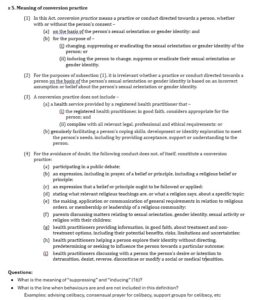
You can take a copy of the relevant parts of the bill to ask them to explain.
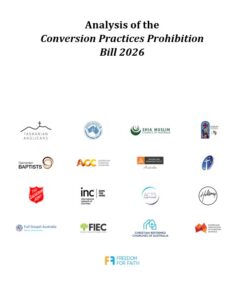
You can also give them a full copy of the Faith Leader’s Analysis, and ask them if they have read it.
If you are meeting with a Labor MP, ask them whether they will allow a conscience vote, like the Liberal Party have. This means each Labor MP could vote based on what they believe rather than be forced to follow the Party line.
Prepare your resources
There are two resources that might be useful to take with you to the meeting.
- Extract from the bill with the definition of a “conversion practice”. This page includes some simple questions to ask an MP if they understand how the definition will work
Bring a copy each for you and the MP to talk through
- The full analysis of the bill by heads of faith.
Bring a copy to give to the MP
At the meeting
Introduce yourself
Start by introducing yourselves and thanking your MP for taking the time to meet with you. Make sure they know who everyone is and understand who you represent. Explain what organisations you are from, where they are, and how many people are members. Also tell them what schools you are connected to, where they are, and approximately how many students attend.
Do not be afraid
MPs are just people, and you can talk to them like everyone else. It is very unlikely that they will be hostile, or even unpleasant to you. If they didn’t want to hear from you they would not have arranged the meeting in the first place. Politicians are also in the business of making friends in their electorate, so they are most likely to be friendly, even if they disagree with you in the end.
Be respectful
Remember to speak clearly, politely, and audibly. Don’t accuse them of bad intentions, but assume that they want the best for the community (even if you don’t agree what that best looks like)
Keep on topic
Keep to the talking points and the issue that is the purpose of the meeting. MPs have limited time, and we can respect them by keeping to the point. Introducing other issues can confuse the conversation and leave the MP unclear as to what we are talking about.
Keep to time
It is likely that you will only have a short amount of time to discuss your issue, so it is important to be clear and concise. You could ask how much time they have to talk. As a rule, 30 minutes is a common appointment length, but they may be willing to talk for longer.
Make sure you finish on time. If possible, aim to finish with a couple of minutes spare, so that the MP is not pressured to move to their next meeting.
Listen
Start by asking the MP what they know of the legislation, and what they think of it. This sets a positive and collaborative tone. It also help you tailor what you are saying to where they are at.
Your MP might be completely new to this issue. There is so much legislation happening at any one time that most MPs only think about it a week before the vote. Ask if they have any questions and help them understand the issue as much as you can. Don’t be afraid of saying you do not know the answer to the question. You are not there to be an expert, but a concerned member of their electorate.
When you raise your concerns, take time to listen to the response. The MP may have been given a series of ‘talking points’ on the issue that may or may not answer your particular concern. If not, gently say that it was not quite what you were asking and re-word.
Ask for a commitment
Don’t be afraid to ask for a commitment, and don’t try to be indirect. Politicians are used to being asked what they think and what they are going to do, and they will appreciate clear concise requests.
Commit to reporting back
This is a very important step, that is sometimes skipped by faith communities.
If the MP is meeting with you as a representative of a larger community of faith, it is important that you make the communication channel 2-way, and commit to telling your community what the outcomes of the meeting were. This way the MP will know that they have an opportunity to speak (through you) with a large part of their electorate.
Some people might feel uncomfortable using their faith community as a ‘platform’ to talk about a politician, because it might be considered acting in a partisan way.
However, the purpose of the sharing is not about promoting a politician, but documenting the commitment that they made so that they can be held to it, and thanking them for their support. Publicly thanking people is a great way of encouraging them, and politicians are no different.
If your MP does not believe that what they say will be conveyed to your wider community, they have less incentive to take the conversation seriously.
Optional: take a photo
One option of communicating to your community is to take a photo with the MP. This photo can be shared on social media or in a newsletter with some text thanking the MP for the meeting and their support for freedom of religion (if they gave any).
The MP may also want to take a photo and post it on their social media, thanking you for the meeting. If they post positive comments about the meeting, then it reinforces in their mind your place in the community and the importance of your concerns.
After the meeting: follow up
Follow up with a letter
An email is a good way of following up, but the way that correspondence is handled by MPs offices means that a more formal letter will generally be treated more seriously. We suggest:
- A written letter (on letterhead, if coming from a church or organisation)
- Emailed as a PDF attachment, with the Faith Leaders’ Analysis also attached
- Also printed and posted (or hand delivered) with the Faith Leaders’ Analysis printed and included.
When writing the letter
- Thank the MP for the meeting
- Remind them of the groups represented in the meeting, and the number of members.
- Reiterate the requests made in the meeting
- Thank them for any commitments they made
Update Your Community
If you have committed to communicating back to your community about the outcomes of the meeting, it is important to do so. If the MP has made some commitments, it is important to thank them for those commitments, and allow your community to know of them. It can also help to let the MP know that you have communicated back. For instance, if you use a newsletter to give an update on the conversation, you could send a copy to the MP’s office. If you took a photo, post it on social media and tag the MP so they can see it too.